



KYCwallet: The Future of Digital Identity
On June 18, 2026 the KYCwallet was presented for the first time at the fourth Open Banking Project Workshop, and it is expected to fundamentally change the way we think about and use digital identity.
© 2026, Eurospider Information Technology AG, GPLv2
What is the KYCwallet?
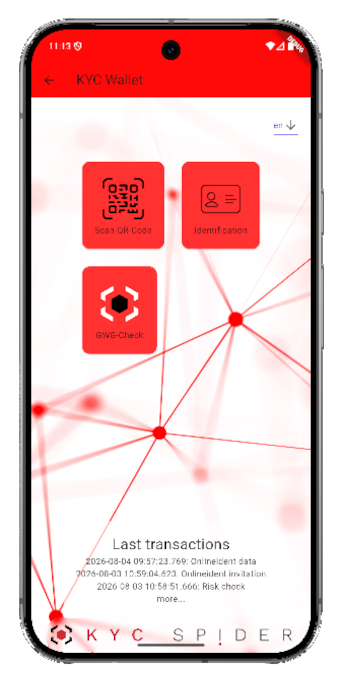
The KYCwallet is an app for personal devices. But unlike traditional wallet apps, which merely store and display digital documents, the KYCwallet goes a decisive step further: It verifies incoming credentials itself and is capable of combining multiple existing credentials into new, complex ones. It is thus an active processing node for trusted digital identity data.
Principle 1: Complete Self-Sovereignty Through Decentralized Identity
Arguably the most defining feature of the KYCwallet is its consistent approach to Self-Sovereign Identity (SSI). The wallet owner has sole control over their own identity data at all times. There is no central server, no platform, and no intermediary that stores, aggregates, or potentially monetizes data.
This represents a fundamental break from the status quo: Today, we entrust our identity data to dozens of platforms, often without knowing exactly what happens to it. The KYCwallet reverses this dynamic. With federated identities, for example, the provider can view usage data and block or delete all access. This is not possible with the KYCwallet.
Principle 2: Recursive Applicability – Proofs Derived from Proofs
A particularly innovative feature is the KYCwallet’s recursive applicability. This means that verified credentials can be linked together and combined to form new, higher-value proofs. A simple example is an electronically verifiable power of attorney. To achieve this, several individually verifiable credentials must be provided - namely, at least two identities and the granted authorization.
This capability makes the KYCwallet a true building block for digital trust architectures. Complex compliance requirements, which today necessitate time-consuming manual processes, could in the future be handled in an automated, privacy-preserving, and user-controlled manner.
Principle 3: Dynamic Credentials in Real Time
Traditional digital credentials have a problem: They are static and can become outdated. An issued credential reflects the status at the time of issuance - not the current status. The KYCwallet also breaks free from this limitation.
It is capable of managing and providing dynamic credentials: documents that update automatically and always reflect the current status. Consider, for example, creditworthiness information, licenses, memberships, or regulatory status information—all of these are types of data that have previously been difficult to capture in standardized, machine-readable, self-sovereign credentials.
Interested in a sneak peek at the KYCwallet? Contact us!
